Monday, January 9, 2012

Anyway vs Anyways


Anyway vs. anyways
as taken from the webpage http://www.grammarist.com/usage/anyways/
Anyways is a colloquial variant of the adverb anyway. It’s generally considered a casualism and thus has no place in formal or serious writing. In such contexts, anyway is usually better.
Anyways is not always inappropriate. In the following examples, the writers use anyways to strike an informal note:
Anyways, it’s time to move on. [NY Times]
Whatever. Home Improvement sucked anyways. [Bleacher Report]
But in writing that is not intended to have a colloquial tone, anyway is usually better—for example:
Why is Google building a Google phone, anyway? [The Atlantic]
It can be nearly impossible to see from publicly available data which banks are extending or restructuring loans they believe will one day fail anyway. [Wall Street Journal]
Anyway, I think it’s pretty hard to make a bad Hurley episode. [Chicago Tribune]
This may change as the English language evolves. For now, though, whether we like it or not, anyways is considered substandard.

Thursday, January 5, 2012

Farther vs Further


Farther versus Further
Throughout history, farther and further have been used interchangeably. Even my friendly Merriam-Webster Dictionary states that the words are interchangeable; they are the inflected form of far. It is not until recent history that they are becoming distinguished by grammarians.

Farther
Farther shows a relation to physical distance. If you can replace the word farther with "more miles" then you have done it correctly.
• Our car drove farther than I thought it would on one tank of gas.
• I wanted to run farther, but I became too exhausted.
• Our house is farther away from the restaurant than yours.
Further
Further relates to metaphorical distance or depth. It is a time, degree, or quantity. It is also another way of saying "additional".
• I asked that there be further discussion on the matter.
• I need to look further into the logistics of moving farther from my office building.
• I hope that gas prices drop further for our road trip vacation.

Well, I hope that this has helped you some. If not, let me know and we can discuss this further. Or was that farther?
Phil

Tuesday, December 20, 2011


Is it “I” or “me?”
Picture this: Jesse Kasserman, a high school senior with a strong academic record and high hopes, walks into the office of Dr. James, an admission representative of XYZ University. “Thank you for inviting my mom and I to see the campus,” he says.
The college representative cringes.
Jesse might have blown the interview already. Why? Jesse should have said “my mom and me.” Smart people everywhere agonize over the misuse of “I” and “me.” It’s one of the most common mistakes in word usage.
People seem to fear the word “me.” Why? Maybe the word “me” reminds us of baby talk, and that makes us nervous. You would never say “Me want a sandwich,” after all. That would be very embarrassing.
But to many people, it sounds just as wrong to hear “The secret is just between you and I.” It’s just wrong.
The official explanation is, “I” is a nominative pronoun and is used as a subject of a sentence or clause, while “me” is an objective pronoun and used as an object. Sound too technical? Then think of this:
The trouble with “me” usually begins when speakers are stringing together two or more objects in a sentence. “I” is not an objective case word, but people try to plug it in as an object because it just sounds smarter.
All you have to do is leave out the second object. Look over these examples, and you’ll see it’s really simple.
You might be tempted to say:
WRONG: “Would you explain that to John and I?”
But then, when you omit the other object, you’ll have:
WRONG: “Would you explain that to I?”
Now that just sounds silly. Try this:
RIGHT: “Would you explain that to John and me?”
RIGHT: “Would you explain that to me?”
Now practice with these:
WRONG: Leave the decision to Laura and I.
RIGHT: Leave the decision to me.
RIGHT: Leave the decision to Laura and me.
WRONG: Please join Glenna and I for lunch.
RIGHT: Please join me for lunch.
RIGHT: Please join Glenna and me for lunch.
WRONG: It’s just between you and I.
RIGHT: It’s just between you and me.
WRONG: The group consists of Laura, Joe, and I.
RIGHT: The group consists of Laura, Joe, and me.
Don't forget, when composing any essay or any research paper, be sure to go back and proof read carefully.

Nominative Pronoun –
Subject of a Sentence –
What Are the Nominative Pronouns?
Here are the nominative pronouns: I, you, he, she, it, they, and we. These are the pronouns that are usually the subject of a sentence – and they do the action in that sentence. A few examples of these nominative pronouns acting as the subject of a sentence are as follows:
• I went to the store today.
• She talked to her brother on the phone.
• You ran five miles yesterday.
• They are not very happy about what happened.
• We work together as a team.
• It is my favorite color.
• He is my best friend.
Here are a few pronouns that are not nominative because they are being affected by the subject and verb: me, them, her, him, us. Here are a few examples of these pronouns in action – can you understand why they are not nominative pronouns?
• My mom told me to go to the store today.
• The coach ordered her to go for a run.
• The students don’t understand him.
• Nobody will listen to me!
• The maid doesn’t want to do the cleaning for them.

Nominative Pronoun
Many people struggle when labeling pronouns by their type, but they usually use these pronouns correctly in a sentence. However, sometimes there are typical mistakes which even native English speakers make. This usually involves using I and me interchangeably. Look at the following two sentences, for example:
1. Sally and me are doing our homework together.
2. Sally and I are doing our homework together.
The second sentence is correct, because “Sally and I” is the subject of the sentence, so the nominative pronoun must be used for the sentence to make sense grammatically. However, the example below completely changes the situation. Can you understand why?
1. The teacher told Sally and me to do our homework.
2. The teacher told Sally and I to do our homework.
Not so fast! If you assumed that you once again had to use “Sally and I” – you were wrong! Many young students drill the mini-phrase “and I” instead of “and me” in their minds because the first is much more commonly correct than the second. Remember, though, that “I” is a nominative pronoun. This means that you can’t use it when it is an object in a sentence. “The teacher” is the subject, which makes “Sally and me” the correct object. Don’t confuse your nominative pronouns with other pronouns, or you’ll find yourself in trouble.
Examples of Nominative Pronouns in Sentences
Look at the following sentences, which all use nominative pronouns correctly.
1. She likes chocolate ice cream.
2. It is a beautiful day outside.
3. He is very tall.
4. They live near my house.
Now look at the following sentences – they all use pronouns incorrectly! Can you use nominative pronouns to fix each sentence?
1. Me like to eat cookies.
2. Her is a very nice lady.
3. Him go to the store to buy milk for breakfast.
4. Them are my neighbors.
In the following examples, can you tell which sentences use nominative pronouns correctly, and which don’t use nominative pronouns correctly? Be careful – these are designed to trick you!
1. I am the team leader.
2. Everyone has to follow what me says.
3. If you want to understand he, then you will have to listen very carefully.
4. Not many people know that her is an astronaut.
For more examples that involve using a nominative pronoun correctly, speak to your English teacher at Wizard and see if he or she can help you – or take a grammar book out at your local library and practice on your own.

Sunday, December 11, 2011

How to Pronounce "the" in English.


How to Pronounce "the" in English

Normally, we pronounce "the" with a short sound (like "thuh"). But when "the" comes before a vowel sound, we pronounce it as a long "thee".

vowel sound

we write

we say

A

the apple

thee apple

E

the egg

thee egg

I

the ice-cream

thee ice-cream

O

the orange

thee orange

U

the ugli fruit

thee ugli fruit

It is important to understand that it is what we say that matters, not what we write. It is the sound that matters, not the letter used in writing a word. So we use a long "thee" before a vowel sound, not necessarily before a vowel. Look at these cases:

we write

with

we say

with

the house

consonant (h)

thuh house

consonant sound

the hour

consonant (h)

thee our

vowel sound

the university

vowel (u)

thuh youniversity

consonant sound

the umbrella

vowel (u)

thee umbrella

vowel sound

Emphatic the [thee]
When we wish to place emphasis on a particular word, we can use "emphatic the" [thee], whether or not the word begins with a consonant or vowel sound. For example:

A: I saw the [thuh] President yesterday.
B: What! The [thee] President of the United States?
A: Yes, exactly.

Wednesday, November 30, 2011

English Improvement Suggestions

Improving Your English

A lot of people are always asking, "How do I improve my English?" There are many possible answers, but here are just a few pieces of advice.

Be responsible for your own learning

Sure you have teachers, reading materials, and websites to help you with your English, but who is really responsible for making sure you learn English well? Nobody but you. Make sure you are the one who is taking charge of your own learning. There is a good article about the subject on the 5 Minute English website. It's at www.5minuteenglish.com/articles. Check it out.

Immerse yourself in English as much as possible

Immerse means to be surrounded by something. If you are immersed in English, it is all around you. Of course this isn't always possible, but you can do some things to surround yourself in English from time to time.

Listen to the radio in English. If there are no English radio stations where you live, listen to one on the internet.

Watch TV and movies in English. If you have English channels on your TV, watch them. If they have subtitles (the words written in your language) underneath the picture, see if they can be turned off. Some people even tape paper across the bottom of the screen so they can't see the words. Most DVD's are great because you can choose the language you want to hear.

Speak English to your friends. Get a conversation buddy (friend) and speak in English as much as possible. If it is a person whose native language is the same as your own, you may feel silly speaking in English at first. But don't worry. Continue to do it and it will become more natural to you. Finding friends whose native language is English is even better. Ask your friend to correct you when needed.

Study or travel to an English-speaking country. Of course the best way to immerse yourself in the English language is to live in an all English environment. You'll find yourself surrounded with the language everywhere you turn. It can be a more difficult and expensive choice, but you may find it to be a very valuable and helpful experience.

Other ideas. Take an English class, join an English group, find a tutor, read English magazines. Do whatever you can to immerse yourself in the language.

Monitor yourself

This means to pay attention to how you use English. Think (a little) about how you are going to say something before it comes out of your mouth. But don't think about all of the problems you have in English at the same time. Just choose something you know you are having difficulty with and work on using it correctly. For example, if you know that you have problems remembering to use a, an, and the, spend a few days trying to put them into sentences as you speak. Don't worry about anything else. Concentrate on that. When you feel that you are improving, choose something else to work on. Just keep trying and little by little, your English will get better everyday.

Friday, September 9, 2011

Life's True Lessons I Learned in Kindergarten

Enjoy this real piece of wisdom.

All I ever needed to know, I learned in Kindergarten

from “All I Really Need To Know I Learned In Kindergarten” by Robert Fulghum


Most of what I really need to know about how to live, and what to do, and how to be, I learned in kindergarten. Wisdom was not at the top the graduate school mountain, but there in the sand box at nursery school.

These are the things I learned. Share everything. Play fair. Don’t hit people. Put things back where you found them. Clean up your own mess. Don’t take things that aren’t yours. Say you are sorry when you hurt somebody. Wash your hands before you eat. Flush. Warm cookies and cold milk are food for you. Live a balanced life. Learn some and think some and draw some and paint and sing and dance and play and work everyday.

Take a nap every afternoon. When you go out in the world, watch for traffic, hold hands, and stick together. Be aware of wonder. Remember the little seed in the plastic cup? The roots go down and the plant goes up and nobody really knows how or why. We are like that.

And then remember that book about Dick and Jane and the first word you learned, the biggest word of all: LOOK! Everything you need to know is there somewhere. The Golden Rule and love and basic sanitation, ecology, and politics and the sane living.

Think of what a better world it would be if we all, the whole world, had cookies and milk about 3 o’clock every afternoon and then lay down with our blankets for a nap. Or we had a basic policy in our nation and other nations to always put things back where we found them and clean up our own messes. And it is still true, no matter how old you are, when you go out in the world, it is best to hold hands and stick together.

So true. Peace.


Wednesday, September 7, 2011

Pink Skink


THE PINK SKINK

By Philip Schanberger

Illustrated by Carol Carone

All rights reserved. © ApplePieBrasil


I once had a pet skink whose color was pink.

Now that’s quite unusual, wouldn’t you think?


He had a long tail that was bit by a mink,

so he dragged it around, complete with a kink.

Once when he was thirsty and needed a drink,

he climbed up the cupboards to the edge of the sink.


When he got to the rim, perched high on the brink,

he lost his balance and was gone in a blink.


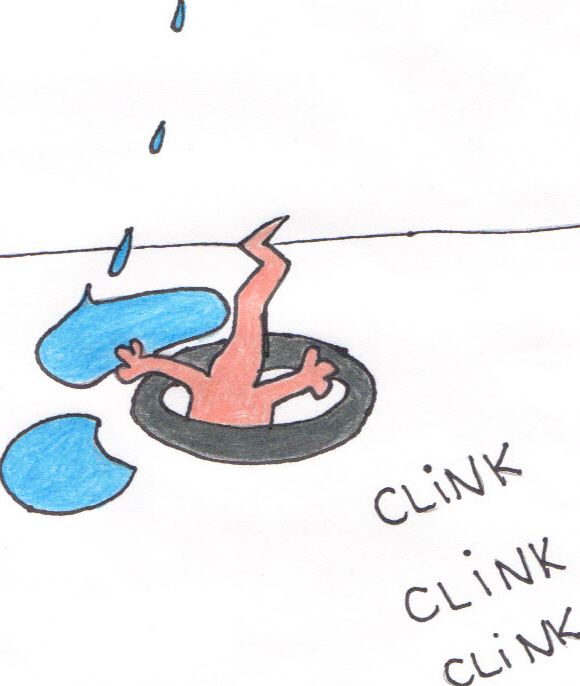
He slid down the drain pipe, plated in zinc,

with his crooked tail going “clink, clink, clink.”


I grabbed my tools and loosened a link,

As he popped out his head, he gave me a wink.


Dirty and grimy, the color of ink,

I was happy to find my little pink skink.

Dedicated to my family:

Kaydon, John, James, Lucas and Momma too.

I love you all.