Friday, November 24, 2017

"The Lonely Trail" Frogs and Toads

It was getting late as the sun aimed for the sea in the west. The weekend was quickly coming to a close. I suddenly had the urge to escape to one of my favorite places - a hidden canyon whose trails knew me well - a place I felt I could walk blindfolded and still see.

Only two hours remained before stars awoke to gaze down on a nocturnal world. Soon after I had left my car and was upon the trail - I started to sense something strange - something odd. Perhaps I should be saying - I sensed my lack of senses.

Here I was - late in the day - at a time when all nature opens her lungs and fills the air with life, with song, whether it be the beautiful whistle of a bird, or the chirp of a cricket - it is the song of nature.

My mind swirled with the thoughts of the day gone by and it was this day that led me to this escape - this canyon whose trails knew me well.

I looked high into the sycamores' crowns - its branches cradling a sleepy sky - but where were the birds - their songs, their chatter. A voice within me suddenly stopped me to say, "Listen, it's a Wren Tit." "No," I said. "It can't be. That's a Towhee no doubt." For that moment I could hear.

But soon I started to look inward again - thinking over the day's events. The day was in a large way, a sad day, but in another way - it was a day of beginning. A day of strengthening bonds. The canyon sounds were drowned out as tears fought their way out of eyes and into the the cool air - now rushing down the hillsides to greet me at the canyon bottom. I actually felt this coolness, but something too was missing here. These early evening breezes always greet the traveler with a potpourri of scents - smells of drying spring and summer grasses, of hillside fennel, of creekside willows and mulefat. it is the smell of nature which always pleases me and surprises me at my ability to smell so many scents.

I noted in my journal at the send of my hike how I missed the feel of the soft earth under my boots and the color of the sunset. My emotions were too wound up to allow my senses to come alive.

On the trail, let go and let nature sink in.

Saturday, November 18, 2017

Pink Skink


THE PINK SKINK

By Philip Schanberger

Narrated by Carol Corone
All rights reserved. © ApplePieBrasil


I once had a pet skink whose color was pink.
Now that’s quite unusual, wouldn’t you think?
He had a long tail that was bit by a mink,
so he dragged it around, complete with a kink.


Two Wings, A Couple Prayers and Some Sleepless Nights to Paradise

It's been a long strange journey - someone once wrote or perhaps sang. But the phrase kept coming back to me everytime I put my head down somewhere to sleep. Ever since we pulled out of Gilbert, Arizona on our trek to Southern California, something new popped into the picture trying its best to rattle the nerves of a tired troop of folks embarking on a serious move in life.


We rolled out of Gilbert late in the morning, way past the original plan of 4am. It was fortunate for two young boys that procrastination was a very large part of our follies - especially that Saturday morning. As I closed the car door and reached for the keys, one of Thiago's best friends raced into the driveway on his bike. Thiago lowered his window screaming, "Rylan, Rylan."


After some discussion back and forth on the plans for the trip, a goodby was tossed back and forth, while I studied Junia's eyes. A pool of tears had formed in each eye and I knew where her thoughts were. Rylan was one of Thiago's dearest friends and the reality was that they would soon be separated by thousands of miles.


We drove west under a warming sun. Already into triple digits, I was anxious to see and feel the coastal paradise of San Diego. We finally arived in San Diego close to sunset.


A call to 411 for the hotel address yielded a strange destination. We located the address after circling several blocks of one-way streets and looked at each other as we pulled into the parking lot of a shoddy looking hotel. At the very least, it would mean a hot shower and a bed to all cram into, but something kept telling me that we were not supposed to be at the Harbor View Inn. A small child peered out from a top story window and I kidded the little ones that she was a ghost that haunted the hotel. Junia walked down to the check in desk fronting a busy downtown street. Lucas raced past her and into the street as we all screamed for him to stop. Inside the smalled crammed lobby I was startled to see the little ghost girl waiting. I wondered how could she be in the lobby so fast. After quizzing the receptionist, Junia determined that we were in the wrong place.


In the parking lot I phoned at least three Holiday Inns with each one responding that they did not have our name on the reservation list. Finally, one hotelgave me a central number to call. Bingo, we confirmed that we had reservations at one of the hotels that I had previously called.


We drove into the Holiday Inn Harbor View around sunset. Gathering two baggage carts, we loaded up all ten bags and additional backpacksa and carry ons. I thought about my family's trips across the US and how good it was to hit the bed each night we stopped after hours of driving. I recalled that the hotels were Holiday Inns or Howard Johnsons.


Saturday, October 20, 2012


WHEN SHE WATCHED THE SKY RAIN GOLD
By Daddy

Kaydon with baby Lucas
November 19, 1995 – To Our Daughter Kaydon


At just over one month of age – she was ready for her first mountain trek. It was to be her second hike already in this young life of hers and she was proving to us that she welcomed an unpaved world.

On this November morning – when sleep is as valuable as the rising stocks of this Saturday morning’s business page – we three decided to venture – beyond the world of pillows and warm sheets – to a world - a young girl had never seen.

We packed up the wagon with a supply of baby essentials – milk, diapers, extra clothes, and plenty of adventurism.

We arrived just past midday at our destination – William Heise Regional Park near Julian, California. We were prepared for a typical cool autumn day with heavy shirts and sweaters, but we were rather – greeted by a typical Santa Ana – minus the winds – day.

Kaydon, after a quick change of clothes, was ready to hit the trail. This day would take her higher than she had ever been in her young life. Her bluing eyes – wide as the heavens above – gathered in like a vacuum, this peaceful world that greeted us.

With some anxiety stirring within me, we decided to set forth on a trail that we had never hiked. Maps to me appear as lines drawn on an artist’s desk – lines that exist for a moment, but disappear when paper is folded. Although essential for safety, they often publish trails too busy with foot traffic.

It is soon evident after fifteen minutes that once again the lines have disappeared and we find ourselves smiling and saying, “Where ever we go – it’s still a beautiful day.”

The trail starts out rather steep and Kaydon chooses to nap as Lisa carries her just behind me. Now and then, as the sun gently shines upon her rosy cheeks, she sneaks a peek and cracks an ever so slight smile. It is, though, a smile, a sign that her heart is awash in love, with a mother’s heart beat against her tiny body and a soft mountain breeze to caress her. It is the purest of smiles.

As the wind slows – this mountain world comes to almost a complete stop. Quiet reigns, but for a moment, broken only occasionally by the flutter of a scrub jay’s wings or some other bird – until the soft wind returns.

Today the wind is a welcomed friend – its coolness – chasing the heat from our necks and drying the dampness on our brows. But aside from its cooling benefits, it brings with it a bit of magic so evident on this autumn day.

As the trail winds down the mountainside, we find ourselves walking beneath a canopy of Black and Canyon Live Oaks. The contrast of the Black Oaks’ yellowing leaves and black branches against a mountain sky so blue is so pleasing to the eye. It is here – while stopped to admire its riches, that a young girl’s sleepy eyes crack open. Perhaps her young ears detect a yawning earth – as a breeze soon begins to comb through the tree tops. What happens next – is one of the reasons this place pulls me back.

Tugged loose from their slumbering branches – dozens upon dozens of black oak leaves yellowed by an autumn clime – float down from above in a golden shower, to the waiting earth.

No longer showing sleepy eyes, Kaydon looks up at the falling gold – with pure amazement filling her eyes – an ever so slight a smile breaks out again. On this autumn day it is the purest of smiles.  At that moment I too feel my heart awash in love convinced by the site of a little girl who watched the sky rain gold.

I love you Kaydon.

Tuesday, July 10, 2012

The Differences Between English and Portuguese

The differences between English and Portuguese Introduction:

Portuguese is a Romance language and part of the Indo-European language family. It is closely related to Spanish. It is spoken by about 180 million people world-wide, principally in Brazil and Portugal. The Portuguese spoken in Europe (EP) and the Portuguese spoken in Brazil (BP) are further apart in terms of pronunciation, spelling and vocabulary than the English spoken in England and the English spoken in the USA.

Alphabet: The Portuguese alphabet consists of 23 letters (lacking the K, W and Y of the English alphabet), plus 11 letters with diacritics such as the Ç. Punctuation corresponds largely to that in English. The English writing system, therefore, presents little difficulty to Portuguese learners. (But see below for problems with spelling.)

Phonology: Brazilian Portuguese is a syllable-timed language, in contrast to English. This can result in learners having serious difficulty reproducing the appropriate intonation patterns of spoken English. This is less of a problem for EP speakers, whose Portuguese variety is stress-timed like English. Portuguese contains about 9 vowel sounds (plus 6 diphthongs) and 19 consonant sounds. This is fewer than English, and there are fewer consonant clusters. These differences can result in the following pronunciation issues:
 • failure to distinguish minimal pairs such as rich/reach, pack/puck orhead/had
 • inaudibility of unstressed vowels at the end of a word, e.g., part (for party)
 • problems with diphthongs such as in hear/hair
 • the inclusion of vowel sounds before, between or following consonants, e.g., estrap (for strap) or monthes (for months)
 • nasalization of the final /m/ or /n/, so ran, for example, becomes rang
 • the expected problems with words such as then, think or breathe
 • failure to discriminate between words such as pig/big or gale/kale
 • substitution of ear for hear or high for I.

These are only some of the pronunciation issues, but they give a good idea of the serious difficulties facing ESL students who want to sound like English native speakers. And they explain why even some very proficient Portuguese speakers of English never lose their accent.

Grammar - Verb/Tense: Much of the English verb system will be familiar to Portuguese learners since the same features exist in their own language. However, some significant differences exist, which may lead to mistakes of negative transfer.

For example, interrogatives in Portuguese are conveyed by intonation. This results in questionable English such as You like me? or He came to school yesterday? The use of the double negative in Portuguese leads to such errors as I don't know nothing.

Tense choice is a significant problem for most learners of English. It is clear that advanced students will struggle, for example, to choose the correct tense to talk about the future or to choose between the present perfect simple and the present perfect continuous. At a less advanced level the main area of difficulty lies in the choice of the appropriate present tense. Mistakes in this area include: He has a bath .. (= he's having a bath ..) / She is knowing .. (she knows ..) / It is ages since I don't play tennis .. (=It's ages since I have played tennis. Beginners also make errors in using modal verbs. Sentences such as I must to go now are common.

Grammar - Other: Portuguese word order is a little more flexible than that of English; and there are variations between the two languages in the placement of adjectives, adverbials or pronouns and in the syntax of sentences containing indirect speech. However, basic Portuguese sentence structure is similar to that of English so learners have no especial difficulty expressing their ideas comprehensibly. Following are some further grammar differences that may result in interference mistakes.

Firstly, English prepositions are difficult for Portuguese learners since their own language has far fewer, and there is no simple correspondence between those that do exist and their English equivalents.

Secondly, there is a single possessive pronoun for his/herwhich agrees in gender with the item 'possessed'. This can lead to ambiguity in sentences such as: She's having lunch with his brother (= her brother). Personal pronouns, especially direct object pronouns, are often omitted in Portuguese, which gives rise to mistakes such as I told (=I told him).

Thirdly, there is only only question tag in Portuguese, in contrast to English which has several different ones depending on the tense and form of the opening words. Errors such as She's coming tomorrow, isn't it? are the result.

Vocabulary: Because of shared Latin roots there are many English/Portuguese cognates, which can facilitate the acquisition of a strong academic vocabulary. (There is less overlap in everyday vocabulary of the two languages.) A corollary of cognates, of course, is the presence of false friends. Here are just a few of the many that wait to trap the Portuguese learner of English: parents <> parentes (=relatives) / familiar <> familiar (=respectable) / local <> local (= place).

Miscellaneous: A spelling reform in Portugal in 1911 made Portuguese spelling much more phonetic in order to help raise standards of literacy in the country. As with all learners whose native language is phonetic, Portuguese ESL students have significant problems spelling English words that they encounter first in spoken language and pronouncing words that they encounter first in written language.

© Copyright Paul Shoebottom 1996-2012 http://esl.fis.edu

Monday, March 12, 2012

Gerunds - Figuring them out.


I commonly see errors with the use of Gerunds or Infinitives. It's natural to confuse these two interesting components of the English language.

Gerunds
Summary: This handout provides a detailed overview (including descriptions and examples) of gerunds, participles, and infinitives.
Contributors:Purdue OWL
Last Edited: 2011-12-09 01:47:54
A gerund is a verbal that ends in -ing and functions as a noun. The term verbal indicates that a gerund, like the other two kinds of verbals, is based on a verb and therefore expresses action or a state of being. However, since a gerund functions as a noun, it occupies some positions in a sentence that a noun ordinarily would, for example: subject, direct object, subject complement, and object of preposition.
Gerund as subject:
• Traveling might satisfy your desire for new experiences. (Traveling is the gerund.)
• The study abroad program might satisfy your desire for new experiences. (The gerund has been removed.)
Gerund as direct object:
• They do not appreciate my singing. (The gerund is singing.)
• They do not appreciate my assistance. (The gerund has been removed)
Gerund as subject complement:
• My cat's favorite activity is sleeping. (The gerund is sleeping.)
• My cat's favorite food is salmon. (The gerund has been removed.)
Gerund as object of preposition:
• The police arrested him for speeding. (The gerund is speeding.)
• The police arrested him for criminal activity. (The gerund has been removed.)
A gerund phrase is a group of words consisting of a gerund and the modifier(s) and/or (pro)noun(s) or noun phrase(s) that function as the direct object(s), indirect object(s), or complement(s) of the action or state expressed in the gerund, such as:
The gerund phrase functions as the subject of the sentence.
Finding a needle in a haystack would be easier than what we're trying to do.
Finding (gerund)
a needle (direct object of action expressed in gerund)
in a haystack (prepositional phrase as adverb)
The gerund phrase functions as the direct object of the verb appreciate.
I hope that you appreciate my offering you this opportunity.
my (possessive pronoun adjective form, modifying the gerund)
offering (gerund)
you (indirect object of action expressed in gerund)
this opportunity (direct object of action expressed in gerund)
The gerund phrase functions as the subject complement.
Tom's favorite tactic has been jabbering away to his constituents.
jabbering away to (gerund)
his constituents (direct object of action expressed in gerund)
The gerund phrase functions as the object of the preposition for.
You might get in trouble for faking an illness to avoid work.
faking (gerund)
an illness (direct object of action expressed in gerund)
to avoid work (infinitive phrase as adverb)
The gerund phrase functions as the subject of the sentence.
Being the boss made Jeff feel uneasy.
Being (gerund)
the boss (subject complement for Jeff, via state of being expressed in gerund)
Punctuation
A gerund virtually never requires any punctuation with it.
Points to remember:
1. A gerund is a verbal ending in -ing that is used as a noun.
2. A gerund phrase consists of a gerund plus modifier(s), object(s), and/or complement(s).
3. Gerunds and gerund phrases virtually never require punctuation.

Monday, January 16, 2012

American Football Basics and New English Vocabulary


AMERICAN FOOTBALL – It’s hard to watch the bouncing pigskin (ball) and it’s hard to understand any sport when first introduced to one.
I thought that this would be a good time to introduce some American culture to my friends in Brazil. After all, they have been kind enough to teach me so much about this country’s beautiful culture, whether it be sports, food, drink, or the wonderful people in this diverse land.

With the National Football League’s season winding down to the final four games of the season (Championship Round: National and American), Pro Bowl and the Superbowl), I got the idea of posting some general and not so general notes on my blog about football. First, a little history:

HISTORY: History of Football
American football was started in 1879 with rules instituted by Walter Camp.
By Mary Bellis, About.com Guide

The Pigskin aka Playing Ball
Derived from the English game of rugby, American football was started in 1879 with rules instituted by Walter Camp, player and coach at Yale University.
Walter Camp
Walter Camp was born April 17, 1859, in New Haven, Connecticut. He attended Yale from 1876 to 1882, where he studied medicine and business. Walter Camp was an author, athletic director, chairman of the board of the New Haven Clock Company, and director of the Peck Brothers Company. He was general athletic director and head advisory football coach at Yale University from 1888-1914, and chairman of the Yale football committee from 1888-1912. Camp played football at Yale and helped evolve the rules of the game away from Rugby and Soccer rules into the rules of American Football as we know them today.
One precursor to Walter Camp's influence was William Ebb Ellis, a student at the Rugby School in England. In 1823, Ellis was the first person noted for picking up the ball during the soccer game and running with it, thereby breaking and changing the rules. In 1876, at the Massosoit convention, the first attempts at writing down the rules of American football were made. Walter Camp edited every American Football rulebook until his death in 1925.
Walter Camp contributed the following changes from Rugby and Soccer to American football:

• one side retained undisputed possession of the ball, until that side gives up
the ball as a result of its own violations
• the line of scrimmage
• 11 on a team instead of 15
• created the quarter-back and center positions
• forward pass
• standardized the scoring system, numerical scoring
• created the safety, interference, penalties, and the neutral zone
• tackling as low as the knee was permitted - 1888
• a touchdown increased in value to six points and field goals went down to
three points - 1912

The NFL or the National Football League, was formed in 1920.
POSITIONS:


SIMPLE ENGLISH IN AMERICAN FOOTBALL: Make sure you checkout the video and English vocabulary lesson at the website below. It will teach you a little more about the game involving not a ball, but a pigskin. Enjoy!

http://funeasyenglish.com/classroom-free-online-english-language-lesson-january-30.htm

TERMINOLOGY: (taken from Dummies.com and written by Howie Long and John Czarnecki);
Football fans have their own language when they talk about the game. To keep up, it’s useful to know what terms like down, extra point, safety, and snap mean.

• Down: A period of action that starts when the ball is put into play and ends when the ball is ruled dead (meaning that the play is completed). The offense gets four downs to advance the ball 10 yards. If it fails to do so, it must surrender the ball to the opponent, usually by punting on the fourth down.

• End zone: A 10-yard-long area at both ends of the field — the promised land for a football player. You score a touchdown when you enter the end zone in control of the football. If you’re tackled in your own end zone while in possession of the football, the other team gets a safety.

• Extra point: A kick, worth one point, that’s typically attempted after every touchdown (it’s also known as the point after touchdown, or PAT). The ball is placed on either the 2-yard line (NFL) or the 3-yard line (college and high school) and generally is kicked from inside the 10-yard line after being snapped to the holder. It must sail between the uprights and above the crossbar of the goalpost to be considered good.

• Field goal: A kick, worth three points, that can be attempted from anywhere on the field but usually is attempted within 40 yards of the goalpost. Like an extra point, a kick must sail above the crossbar and between the uprights of the goalpost to be ruled good.

• Fumble: The act of losing possession of the ball while running with it or being tackled. Members of the offense and defense can recover a fumble. If the defense recovers the fumble, the fumble is called a turnover.

• Hash marks: The lines on the center of the field that signify 1 yard on the field. Before every play, the ball is spotted between the hash marks or on the hash marks, depending on where the ball carrier was tackled on the preceding play.

• Interception: A pass that’s caught by a defensive player, ending the offense’s possession of the ball.

• Kickoff: A free kick (the receiving team can’t make an attempt to block it) that puts the ball into play. A kickoff is used at the start of the first and third periods and after every touchdown and successful field goal.

• Punt: A kick made when a player drops the ball and kicks it while it falls toward his foot. A punt is usually made on a fourth down when the offense must surrender possession of the ball to the defense because it couldn’t advance 10 yards.

• Return: The act of receiving a kick or punt and running toward the opponent’s goal line with the intent of scoring or gaining significant yardage.

• Sack: When a defensive player tackles the quarterback behind the line of scrimmage for a loss of yardage.

• Safety: A score, worth two points, that the defense earns by tackling an offensive player in possession of the ball in his own end zone.

• Snap: The action in which the ball is hiked (tossed between the legs) by the center to the quarterback, to the holder on a kick attempt, or to the punter. When the snap occurs, the ball is officially in play and action begins.

• Touchdown: A score, worth six points, that occurs when a player in possession of the ball crosses the plane of the opponent’s goal line, or when a player catches the ball while in the opponent’s end zone, or when a defensive player recovers a loose ball in the opponent’s end zone.


NOTE: I'll be posting more about this sport in the coming days and weeks. I hope at the very least, you learn some basics and some new English.

Monday, January 9, 2012

Anyway vs Anyways


Anyway vs. anyways
as taken from the webpage http://www.grammarist.com/usage/anyways/
Anyways is a colloquial variant of the adverb anyway. It’s generally considered a casualism and thus has no place in formal or serious writing. In such contexts, anyway is usually better.
Anyways is not always inappropriate. In the following examples, the writers use anyways to strike an informal note:
Anyways, it’s time to move on. [NY Times]
Whatever. Home Improvement sucked anyways. [Bleacher Report]
But in writing that is not intended to have a colloquial tone, anyway is usually better—for example:
Why is Google building a Google phone, anyway? [The Atlantic]
It can be nearly impossible to see from publicly available data which banks are extending or restructuring loans they believe will one day fail anyway. [Wall Street Journal]
Anyway, I think it’s pretty hard to make a bad Hurley episode. [Chicago Tribune]
This may change as the English language evolves. For now, though, whether we like it or not, anyways is considered substandard.

Thursday, January 5, 2012

Farther vs Further


Farther versus Further
Throughout history, farther and further have been used interchangeably. Even my friendly Merriam-Webster Dictionary states that the words are interchangeable; they are the inflected form of far. It is not until recent history that they are becoming distinguished by grammarians.

Farther
Farther shows a relation to physical distance. If you can replace the word farther with "more miles" then you have done it correctly.
• Our car drove farther than I thought it would on one tank of gas.
• I wanted to run farther, but I became too exhausted.
• Our house is farther away from the restaurant than yours.
Further
Further relates to metaphorical distance or depth. It is a time, degree, or quantity. It is also another way of saying "additional".
• I asked that there be further discussion on the matter.
• I need to look further into the logistics of moving farther from my office building.
• I hope that gas prices drop further for our road trip vacation.

Farther shows a relation to physical distance. If you can replace the word farther with "more miles" then you have done it correctly.
• Our car drove farther than I thought it would on one tank of gas.
• I wanted to run farther, but I became too exhausted.
• Our house is farther away from the restaurant than yours.
Further
Further relates to metaphorical distance or depth. It is a time, degree, or quantity. It is also another way of saying "additional".
• I asked that there be further discussion on the matter.
• I need to look further into the logistics of moving farther from my office building.
• I hope that gas prices drop further for our road trip vacation.

Well, I hope that this has helped you some. If not, let me know and we can discuss this further. Or was that farther?
Phil

Tuesday, December 20, 2011


Is it “I” or “me?”
Picture this: Jesse Kasserman, a high school senior with a strong academic record and high hopes, walks into the office of Dr. James, an admission representative of XYZ University. “Thank you for inviting my mom and I to see the campus,” he says.
The college representative cringes.
Jesse might have blown the interview already. Why? Jesse should have said “my mom and me.” Smart people everywhere agonize over the misuse of “I” and “me.” It’s one of the most common mistakes in word usage.
People seem to fear the word “me.” Why? Maybe the word “me” reminds us of baby talk, and that makes us nervous. You would never say “Me want a sandwich,” after all. That would be very embarrassing.
But to many people, it sounds just as wrong to hear “The secret is just between you and I.” It’s just wrong.
The official explanation is, “I” is a nominative pronoun and is used as a subject of a sentence or clause, while “me” is an objective pronoun and used as an object. Sound too technical? Then think of this:
The trouble with “me” usually begins when speakers are stringing together two or more objects in a sentence. “I” is not an objective case word, but people try to plug it in as an object because it just sounds smarter.
All you have to do is leave out the second object. Look over these examples, and you’ll see it’s really simple.
You might be tempted to say:
WRONG: “Would you explain that to John and I?”
But then, when you omit the other object, you’ll have:
WRONG: “Would you explain that to I?”
Now that just sounds silly. Try this:
RIGHT: “Would you explain that to John and me?”
RIGHT: “Would you explain that to me?”
Now practice with these:
WRONG: Leave the decision to Laura and I.
RIGHT: Leave the decision to me.
RIGHT: Leave the decision to Laura and me.
WRONG: Please join Glenna and I for lunch.
RIGHT: Please join me for lunch.
RIGHT: Please join Glenna and me for lunch.
WRONG: It’s just between you and I.
RIGHT: It’s just between you and me.
WRONG: The group consists of Laura, Joe, and I.
RIGHT: The group consists of Laura, Joe, and me.
Don't forget, when composing any essay or any research paper, be sure to go back and proof read carefully.

Nominative Pronoun –
Subject of a Sentence –
What Are the Nominative Pronouns?
Here are the nominative pronouns: I, you, he, she, it, they, and we. These are the pronouns that are usually the subject of a sentence – and they do the action in that sentence. A few examples of these nominative pronouns acting as the subject of a sentence are as follows:
• I went to the store today.
• She talked to her brother on the phone.
• You ran five miles yesterday.
• They are not very happy about what happened.
• We work together as a team.
• It is my favorite color.
• He is my best friend.
Here are a few pronouns that are not nominative because they are being affected by the subject and verb: me, them, her, him, us. Here are a few examples of these pronouns in action – can you understand why they are not nominative pronouns?
• My mom told me to go to the store today.
• The coach ordered her to go for a run.
• The students don’t understand him.
• Nobody will listen to me!
• The maid doesn’t want to do the cleaning for them.

Nominative Pronoun
Many people struggle when labeling pronouns by their type, but they usually use these pronouns correctly in a sentence. However, sometimes there are typical mistakes which even native English speakers make. This usually involves using I and me interchangeably. Look at the following two sentences, for example:
1. Sally and me are doing our homework together.
2. Sally and I are doing our homework together.
The second sentence is correct, because “Sally and I” is the subject of the sentence, so the nominative pronoun must be used for the sentence to make sense grammatically. However, the example below completely changes the situation. Can you understand why?
1. The teacher told Sally and me to do our homework.
2. The teacher told Sally and I to do our homework.
Not so fast! If you assumed that you once again had to use “Sally and I” – you were wrong! Many young students drill the mini-phrase “and I” instead of “and me” in their minds because the first is much more commonly correct than the second. Remember, though, that “I” is a nominative pronoun. This means that you can’t use it when it is an object in a sentence. “The teacher” is the subject, which makes “Sally and me” the correct object. Don’t confuse your nominative pronouns with other pronouns, or you’ll find yourself in trouble.
Examples of Nominative Pronouns in Sentences
Look at the following sentences, which all use nominative pronouns correctly.
1. She likes chocolate ice cream.
2. It is a beautiful day outside.
3. He is very tall.
4. They live near my house.
Now look at the following sentences – they all use pronouns incorrectly! Can you use nominative pronouns to fix each sentence?
1. Me like to eat cookies.
2. Her is a very nice lady.
3. Him go to the store to buy milk for breakfast.
4. Them are my neighbors.
In the following examples, can you tell which sentences use nominative pronouns correctly, and which don’t use nominative pronouns correctly? Be careful – these are designed to trick you!
1. I am the team leader.
2. Everyone has to follow what me says.
3. If you want to understand he, then you will have to listen very carefully.
4. Not many people know that her is an astronaut.
For more examples that involve using a nominative pronoun correctly, speak to your English teacher at Wizard and see if he or she can help you – or take a grammar book out at your local library and practice on your own.

Sunday, December 11, 2011

How to Pronounce "the" in English.


How to Pronounce "the" in English

Normally, we pronounce "the" with a short sound (like "thuh"). But when "the" comes before a vowel sound, we pronounce it as a long "thee".

vowel sound

we write

we say

A

the apple

thee apple

E

the egg

thee egg

I

the ice-cream

thee ice-cream

O

the orange

thee orange

U

the ugli fruit

thee ugli fruit

It is important to understand that it is what we say that matters, not what we write. It is the sound that matters, not the letter used in writing a word. So we use a long "thee" before a vowel sound, not necessarily before a vowel. Look at these cases:

we write

with

we say

with

the house

consonant (h)

thuh house

consonant sound

the hour

consonant (h)

thee our

vowel sound

the university

vowel (u)

thuh youniversity

consonant sound

the umbrella

vowel (u)

thee umbrella

vowel sound

Emphatic the [thee]
When we wish to place emphasis on a particular word, we can use "emphatic the" [thee], whether or not the word begins with a consonant or vowel sound. For example:

A: I saw the [thuh] President yesterday.
B: What! The [thee] President of the United States?
A: Yes, exactly.

Wednesday, November 30, 2011

English Improvement Suggestions

Improving Your English

A lot of people are always asking, "How do I improve my English?" There are many possible answers, but here are just a few pieces of advice.

Be responsible for your own learning

Sure you have teachers, reading materials, and websites to help you with your English, but who is really responsible for making sure you learn English well? Nobody but you. Make sure you are the one who is taking charge of your own learning. There is a good article about the subject on the 5 Minute English website. It's at www.5minuteenglish.com/articles. Check it out.

Immerse yourself in English as much as possible

Immerse means to be surrounded by something. If you are immersed in English, it is all around you. Of course this isn't always possible, but you can do some things to surround yourself in English from time to time.

Listen to the radio in English. If there are no English radio stations where you live, listen to one on the internet.

Watch TV and movies in English. If you have English channels on your TV, watch them. If they have subtitles (the words written in your language) underneath the picture, see if they can be turned off. Some people even tape paper across the bottom of the screen so they can't see the words. Most DVD's are great because you can choose the language you want to hear.

Speak English to your friends. Get a conversation buddy (friend) and speak in English as much as possible. If it is a person whose native language is the same as your own, you may feel silly speaking in English at first. But don't worry. Continue to do it and it will become more natural to you. Finding friends whose native language is English is even better. Ask your friend to correct you when needed.

Study or travel to an English-speaking country. Of course the best way to immerse yourself in the English language is to live in an all English environment. You'll find yourself surrounded with the language everywhere you turn. It can be a more difficult and expensive choice, but you may find it to be a very valuable and helpful experience.

Other ideas. Take an English class, join an English group, find a tutor, read English magazines. Do whatever you can to immerse yourself in the language.

Monitor yourself

This means to pay attention to how you use English. Think (a little) about how you are going to say something before it comes out of your mouth. But don't think about all of the problems you have in English at the same time. Just choose something you know you are having difficulty with and work on using it correctly. For example, if you know that you have problems remembering to use a, an, and the, spend a few days trying to put them into sentences as you speak. Don't worry about anything else. Concentrate on that. When you feel that you are improving, choose something else to work on. Just keep trying and little by little, your English will get better everyday.

Friday, September 9, 2011

Life's True Lessons I Learned in Kindergarten

Enjoy this real piece of wisdom.

All I ever needed to know, I learned in Kindergarten

from “All I Really Need To Know I Learned In Kindergarten” by Robert Fulghum


Most of what I really need to know about how to live, and what to do, and how to be, I learned in kindergarten. Wisdom was not at the top the graduate school mountain, but there in the sand box at nursery school.

These are the things I learned. Share everything. Play fair. Don’t hit people. Put things back where you found them. Clean up your own mess. Don’t take things that aren’t yours. Say you are sorry when you hurt somebody. Wash your hands before you eat. Flush. Warm cookies and cold milk are food for you. Live a balanced life. Learn some and think some and draw some and paint and sing and dance and play and work everyday.

Take a nap every afternoon. When you go out in the world, watch for traffic, hold hands, and stick together. Be aware of wonder. Remember the little seed in the plastic cup? The roots go down and the plant goes up and nobody really knows how or why. We are like that.

And then remember that book about Dick and Jane and the first word you learned, the biggest word of all: LOOK! Everything you need to know is there somewhere. The Golden Rule and love and basic sanitation, ecology, and politics and the sane living.

Think of what a better world it would be if we all, the whole world, had cookies and milk about 3 o’clock every afternoon and then lay down with our blankets for a nap. Or we had a basic policy in our nation and other nations to always put things back where we found them and clean up our own messes. And it is still true, no matter how old you are, when you go out in the world, it is best to hold hands and stick together.

So true. Peace.


Wednesday, September 7, 2011

Pink Skink


THE PINK SKINK

By Philip Schanberger

Illustrated by Carol Carone

All rights reserved. © ApplePieBrasil


I once had a pet skink whose color was pink.

Now that’s quite unusual, wouldn’t you think?


He had a long tail that was bit by a mink,

so he dragged it around, complete with a kink.

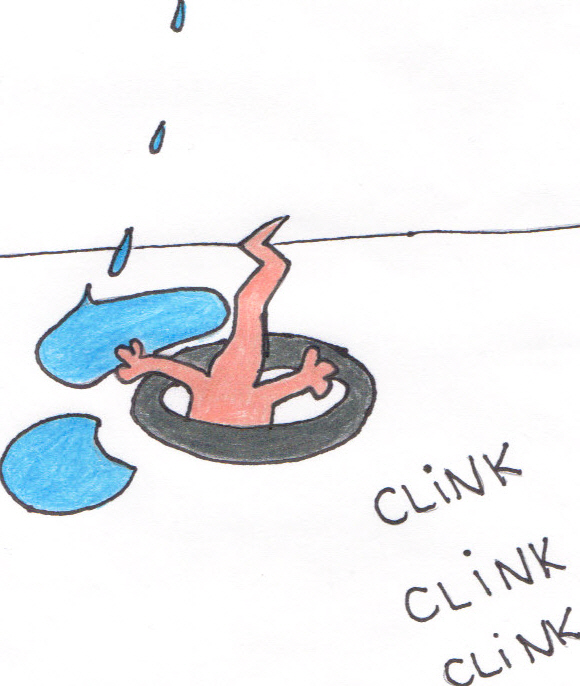
Once when he was thirsty and needed a drink,

he climbed up the cupboards to the edge of the sink.


When he got to the rim, perched high on the brink,

he lost his balance and was gone in a blink.


He slid down the drain pipe, plated in zinc,

with his crooked tail going “clink, clink, clink.”


I grabbed my tools and loosened a link,

As he popped out his head, he gave me a wink.


Dirty and grimy, the color of ink,

I was happy to find my little pink skink.

Dedicated to my family:

Kaydon, John, James, Lucas and Momma too.

I love you all.

We're not so different, well kind a sort of......

Here is a list of words that we use in English that have some root (history) in Portuguese. This may help you learn your English a little quicker now that we already speak the same language. Well, in so many words we do.

This is a list of English words potentially borrowed or derived from Portuguese (or Galician-Portuguese). The list also includes words originally derived from other languages:

Albacore
from albacor from Arabic بكورة al-bukr (="the young camels")
Albino
from albino, with the same meaning, from Latin albus
Albatross
an alteration of albatroz, under influence of the Latin word albus ("white");
Alcatraz
(="gannet") from Arabic غطاس al-ġaţţās ("the diver")

Amah
from Portuguese ama, nurse, housemaid, from Medieval Latin amma, mother
Anil
from anil, through French, via Arabic النيل al-nili and Persian نیلا nila; ultimately from Sanskrit नीली nili (="indigo).
Auto-da-fé, a judicial 'act' or sentence of the Inquisition
from auto da fé (= "act/sentence of faith")
Banana
from Portuguese or Spanish (more probably from Portuguese, as the most widespread Spanish word is plátano); from Portuguese, of African origin; akin to Wolof banäna banana
Baroque
from barroco (adj. = "unshapely")
Breeze
(= "from Portuguese word brisa")
Bossa nova
(= "new trend" or "new wave")
Buccaneer
from Tupi mukém

Cachalot
from Portuguese cachalote (same meaning), probably via Spanish or French. The Portuguese word comes from cachola ("head" or "big head").
Carambola
Portuguese, perhaps from Marathi कराम्बल karambal
Caramel
from caramelo, caramel, from Late Latin calamellus
Caravel
from caravela
Carioca
from Tupi "carioca" (cari = white men, oca = house; house of the white men), via Portuguese carioca (native of Rio de Janeiro)
Carnauba
from carnaúba
Caste
from casta (="class")
Cashew
from caju (a tropical fruit)
Cobra
shortening of cobra-de-capelo, with the same meaning (literally, "snake with a hood").
Coconut
from coco (coconut)
Commando
from comando (="command")
Cougar
from French couguar, from Portuguese suçuarana, perhaps from Tupian sɨwasuarána or Guaraní guaçu ara.
Cow-tree
a tree abundant in a milk-like juice : from árvore, pau de vaca (="tree of cow")
Creole
French créole, from Castilian Spanish criollo, person native to a locality, from Portuguese crioulo, diminutive of cria, ("'person raised in one's house with no blood relation, a servant'"), < Portuguese criar ("'to rear, to raise, to bring up'") , from Latin creare, to beget; < Latin creo ("'to create'"), which came into English via French between 1595 and 1605. [same root as creature]
Dodo
According to Encarta Dictionary and Chambers Dictionary of Etymology, "dodo" comes from Portuguese doudo (currently, more often,doido) meaning "fool" or "crazy". The present Portuguese word dodô ("dodo") is of English origin. The Portuguese word doudo or doidomay itself be a loanword from Old English (cp. English "dolt").
Embarass
from Portuguese embaraçar (same meaning; also to tangle - string or rope ), from em + baraço (archaic for "rope")[1]
Emu
from ema (="rhea")

Fetish
from French fétiche, from Portuguese feitiço ("charm", "sorcery", "spell"), from Latin factitius or feticius ("artificial")
Flamingo
from Portuguese flamingo, from Spanish flamenco
Grouper
from garoupa
Guarana
from Portuguese guaraná, from Tupi warana
Jaguar
from Tupi or Guaraní jaguarete via Portuguese
Junk
from junco, from Javanese djong (Malay adjong).
Lambada
from lambada (="beating, lashing")
Macaque
from macaco, through French
Macaw
from macau; ultimately from Tupi macavuana.
Mandarin
from mandarim, from the Portuguese verb mandar (='to rule; to send') via the Dutch mandorijn, from the Malay mantri, from Hindi मंत्रीmatri, from Sanskrit मन्त्रिन् mantrin (="counsellor")
Mango
from manga, via Malay mangga, ultimately from Malayalam മാങ്ങ māṅṅa or from Tamil மாங்காய் mānkāy
Mangrove
probably from Portuguese mangue mangrove (from Spanish mangle, probably from Taino) + English grove
Manioc
from mandioca (="cassava") from Tupi mandioca.
Maraca
from maracá from Tupi
Marimba
from Portuguese, of Bantu origin; akin to Kimbundu ma-rimba : ma-, pl. n. pref. + rimba, xylophone, hand piano
Marmalade
from marmelada, a preserve made from marmelo (="quince")
Molasses
from melaço (="treacle")
Monsoon
from monção
Mosquito
from Mosquito meaning 'little fly'
Mulatto
Portuguese mulato. From mula (=mule) a cross between a horse and a donkey or from the Arabic term muwallad, which means "a person of mixed ancestry"
Negro
Negro means "black" in Spanish, Portuguese, and Italian, being from the Latin word niger (Dative nigro, Accusative nigrum) and the Greekword Νέγρος Negros both of the same meaning. It came to English through the Portuguese and Spanish slave trade. Prior to the 1970s, it was the dominant term for Black people of African origin; in most English language contexts (except its inclusion in the names of some organizations founded when the term had currency, e.g. the United Negro College Fund), it is now considered either archaic or a slur in most contexts.

Pagoda
from pagode; corruption of Persian بوتکاتا butkata (+"idol deity")
Palaver
a chat, from palavra (="word"), Portuguese palavra (word), parabola (parable), speech (current fala, discurso), chat (current bate-papo, papo {pronunc. : bahtchy papoo}, palavrinha, conversa and also Eng. chat) alteration of Late Latin parabola, speech, parable.
Palmyra
from palmeira (="palm")
Pickaninny
from pequenina (="little one") or pequeninha (="toddler")
Piranha
from piranha (=piranha), from Tupi pirá ("fish") + ánha ("cut")
potato
from "batata"
Sablefish
from sável (="shad," "whitefish")
Samba
from samba ; ultimately of Angolan origin, semba
Sargasso
from sargaço (="sargasso")
Savvy
from sabe he knows, from saber to know
Stevedore
from estivador (="stevedore")
Tank
from tanque
Tapioca
from tapioca
Teak
from teca
Tempura
Japanese 天麩羅, tenpura?, also written as "天ぷら", from Portuguese têmporas, (=Ember Days)
Verandah
from varanda (="balcony" or "railing"), from Hindi वरांडा varanda or Bengali baranda
Yam
from inhame or Spanish igname from West African nyama (="eat")
Zebra
from zebra (same meaning), which started as the feminine form of zebro (a kind of deer), from vulgar Latin eciferus, classical LatinEQUIFERVS.

[edit]